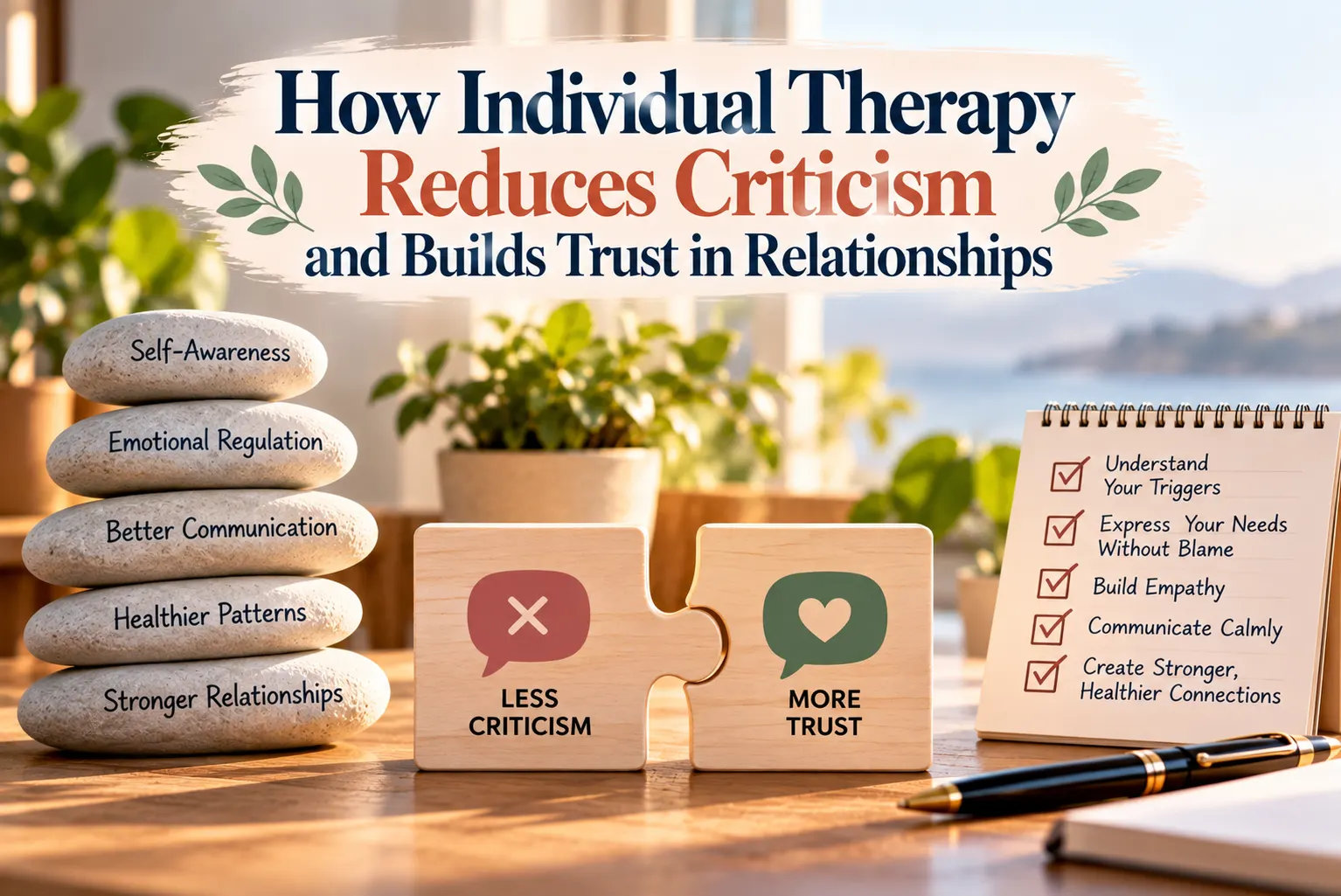
Healthy relationships depend on communication, mutual respect, and trust. However, when disagreements repeatedly turn into criticism, defensiveness, or emotional withdrawal, even strong relationships can become strained. Small misunderstandings may escalate into arguments, leaving both people feeling unheard or misunderstood.
Learning how to communicate without blame is an important step toward healthier relationships. Individual therapy reduces criticism by helping people understand their emotional triggers, recognize unhelpful communication patterns, and develop more constructive ways to express their needs.
You do not necessarily need your partner to attend therapy to begin making meaningful changes. Individual therapy provides a space to explore your own reactions, understand the experiences that influence your behavior, and practice healthier responses to conflict.
At Christine Bilbrey, MD, PC, therapy and psychiatric care can help individuals explore emotional challenges and work toward improved well-being and healthier interpersonal relationships.
1. Why Does Criticism Damage Trust in Relationships?
Criticism becomes harmful when it moves beyond discussing a specific behavior and begins attacking someone’s character, intentions, or worth.
For example, saying, “I felt hurt when you canceled our plans without telling me,” communicates a concern. Saying, “You never care about anyone but yourself,” makes a broader judgment about the other person’s character.
Repeated criticism can make people feel defensive, inadequate, or reluctant to express themselves honestly. One person may criticize more intensely to get their needs met, while the other withdraws to avoid another argument.
Over time, this pattern can weaken emotional connection and make everyday conversations feel uncomfortable.
Common Signs of Destructive Criticism Include:
- Using words such as “always” and “never” during disagreements.
- Bringing up past mistakes during unrelated arguments.
- Making assumptions about another person’s intentions.
- Using sarcasm or contempt to express frustration.
- Focusing on blame rather than finding solutions.
- Treating disagreement as proof that someone does not care.
Recognizing these patterns is the first step toward changing them.
2. How Individual Therapy Reduces Criticism
Individual therapy reduces criticism by helping people understand the emotions, beliefs, and reactions that influence their communication.
Sometimes criticism develops from frustration or unmet expectations. In other situations, it may be connected to anxiety, perfectionism, insecurity, past experiences, or difficulty expressing vulnerability.
A therapist can help you explore questions such as:
- What situations make me feel most defensive?
- What am I afraid will happen when someone disagrees with me?
- Do I interpret mistakes as rejection or disrespect?
- How do I communicate when I feel ignored?
- Can I express disappointment without attacking someone’s character?
For example, someone who frequently criticizes their partner for forgetting household tasks might discover that their frustration is connected to feeling unsupported.
Instead of repeatedly saying, “You never help me,” they can learn to communicate the underlying need more directly: “I’m feeling overwhelmed managing these responsibilities. Can we work out a more balanced plan?”
This approach does not eliminate disagreement. It makes disagreement more constructive by focusing on the issue rather than attacking the person.
3. Understanding Emotional Triggers Before Reacting
An emotional trigger is a situation that produces a strong emotional response because of its personal meaning or connection to previous experiences.
Being interrupted, receiving feedback, feeling ignored, or encountering an unexpected change may trigger anger, shame, anxiety, or fear.
Without awareness, these feelings can quickly turn into criticism.
Individual therapy can help you recognize the connection between a situation, your interpretation of it, the emotion you experience, and your response.
Consider this example: your partner forgets an important commitment. You immediately think, “I don’t matter to them.” That interpretation creates hurt and anger, which leads to an accusation.
Therapy can help you pause and consider alternative explanations before responding. You can still communicate that the forgotten commitment hurt you without assuming it proves the other person does not care.
Recognizing emotional triggers gives you an opportunity to respond intentionally instead of reacting automatically.
4. Replacing Blame With Clear Communication
Healthy communication allows people to express concerns without making the other person feel personally attacked.
Individual therapy can help you practice expressing emotions, needs, and boundaries in a direct and respectful way.
Here are some practical examples:
| Instead of saying | Try saying |
| “You never listen to me.” | “I’d like to finish explaining how I feel before we discuss solutions.” |
| “You’re always so defensive.” | “I feel like we’re getting stuck in an argument. Can we slow down?” |
| “You don’t care about my feelings.” | “I felt hurt by what happened, and I’d like to talk about it.” |
| “You always disappoint me.” | “I was counting on this commitment, and I’m disappointed it didn’t happen.” |
| “You need to change.” | “I’d like us to find a way to handle this differently.” |
These alternatives do not guarantee agreement, but they make it easier to communicate concerns without broad judgments about another person’s character.
The goal is to be honest about your feelings while remaining respectful of the other person’s dignity.
5. Building Emotional Regulation During Conflict
Trust can be difficult to maintain when disagreements repeatedly escalate into shouting, harsh criticism, or emotional withdrawal.
Emotional regulation involves recognizing feelings and managing your responses rather than allowing intense emotions to determine your behavior.
Individual therapy may help you develop practical skills such as:
- Pausing before responding to a difficult comment.
- Identifying physical signs of rising frustration.
- Taking a break when a conversation becomes overwhelming.
- Challenging assumptions about another person’s intentions.
- Returning to a difficult conversation when you feel calmer.
- Acknowledging emotions without acting on every impulse.
For example, if you notice that your voice is getting louder during an argument, you might say, “I’m getting frustrated, and I want to handle this respectfully. Can we take a short break and come back to this?”
A pause is most helpful when it is communicated clearly and followed by a genuine return to the discussion. Otherwise, it may feel like avoidance or punishment.
Learning to manage emotional reactions can create more room for listening, understanding, and problem-solving.
6. How Individual Therapy Builds Trust Without Your Partner Attending
You do not necessarily need your partner or family member to attend therapy to work on your own relationship patterns.
Individual therapy focuses on your thoughts, emotions, communication habits, boundaries, and responses to conflict. As you develop these skills, your interactions with others may change.
You might become better at acknowledging mistakes, listening without immediately defending yourself, expressing needs directly, or recognizing when a disagreement is becoming unproductive.
These changes can create opportunities for healthier interactions, even if the other person has not started therapy.
However, individual therapy cannot guarantee that another person will change or that a relationship will improve. Rebuilding mutual trust usually requires consistent effort and accountability from everyone involved.
If both people want to address recurring relationship difficulties, couples therapy may also be worth considering.
7. Recognizing the Influence of Past Experiences
Communication habits often develop through earlier relationships and life experiences.
Someone who grew up around frequent arguments may learn to criticize before they can be criticized. Another person who experienced rejection may become highly sensitive to signs of disappointment or emotional distance.
These responses may have developed as ways of protecting oneself, but they can become unhelpful in adult relationships.
Individual therapy can provide space to explore these patterns without judgment. Depending on your needs, therapy may address:
- Fear of rejection or abandonment.
- Perfectionism and unrealistic expectations.
- Low self-esteem or persistent self-criticism.
- Difficulty trusting others.
- Past relationship conflict.
- Anxiety or stress that affects communication.
- Discomfort with vulnerability.
Understanding the origins of a pattern does not excuse hurtful behavior. Instead, it helps you identify what needs to change and develop more effective ways to respond.
8. Developing Healthier Boundaries and Expectations
Trust does not mean agreeing with everything another person says or accepting every behavior. Healthy relationships allow people to express different opinions, establish boundaries, and maintain individual identities.
Unrealistic expectations can contribute to criticism when someone believes that a partner should automatically understand their needs or respond exactly as expected.
Individual therapy can help you identify expectations that may be creating unnecessary tension.
For example, instead of assuming that someone should know when you need support, you can practice making a clear request. Instead of interpreting every disagreement as rejection, you can learn to tolerate differences while remaining connected.
Boundaries are equally important. You can communicate what behavior you find unacceptable without insulting or attempting to control another person.
Healthy boundaries might involve requesting respectful conversations, limiting discussions that become verbally abusive, or taking time to reflect before making an important decision.
These skills can support trust by making expectations clearer and encouraging mutual respect.
9. What to Expect From Individual Therapy
Individual therapy is a collaborative process tailored to your concerns and goals.
An initial session may involve discussing your relationship history, common sources of conflict, emotional triggers, and communication habits you would like to change.
Depending on your needs, therapy may involve identifying recurring patterns, challenging unhelpful assumptions, practicing communication techniques, and developing strategies for handling difficult situations.
Different therapeutic approaches may be appropriate for different concerns. Cognitive behavioral therapy, for example, can help people examine the relationship between thoughts, feelings, and behaviors. Other approaches may focus on emotional experiences, interpersonal patterns, or relationship history.
Progress varies from person to person. Some people notice changes as they begin recognizing their reactions, while more deeply established patterns may take longer to change.
The goal is to develop skills that you can use outside the therapy room, including during disagreements, stressful conversations, and moments when trust feels difficult.
10. How Christine Bilbrey, MD, PC Can Help
If recurring criticism, defensiveness, or relationship conflict is affecting your emotional well-being, professional support may help you better understand these patterns.
Christine Bilbrey, MD, PC provides psychiatric care and psychotherapy for individuals seeking support with emotional and mental health concerns. An individualized approach can help you explore the thoughts, feelings, and behaviors that influence your relationships and overall well-being.
Through therapy, you may work toward recognizing emotional triggers, communicating needs more effectively, setting healthy boundaries, and responding to disagreements more constructively.
The appropriate treatment approach depends on your circumstances, concerns, and goals. A professional consultation can help you understand which services may be suitable for your needs.
You do not have to wait until relationship difficulties become overwhelming before seeking support.
Visit Christine Bilbrey, MD, PC to learn more about the practice and its psychiatric care and therapy services.
Final Thoughts
Criticism can become a deeply ingrained communication habit, especially when frustration, insecurity, or unresolved emotional experiences influence how people respond to one another.
Individual therapy reduces criticism by helping people recognize these patterns, understand their emotional triggers, and develop healthier ways to express needs and manage conflict. With consistent practice, these skills can support more respectful conversations and create opportunities for trust to grow.
You cannot control another person’s reactions, but you can work toward communicating with greater awareness, accountability, and empathy.
If recurring criticism or relationship conflict is affecting your emotional well-being, individual therapy may be a useful place to begin.
Take the next step toward healthier relationships. Visit Christine Bilbrey, MD, PC to learn more about the practice’s therapy and psychiatric services.
FAQs
Can individual therapy really reduce criticism in relationships?
Individual therapy can help you recognize triggers, understand the emotions behind critical reactions, and practice more constructive communication. Results vary, and relationship improvement also depends on the circumstances and the other person’s behavior.
Can individual therapy build trust if my partner refuses to attend?
Yes. You can work on your communication habits, boundaries, emotional regulation, and responses to conflict without your partner attending. However, rebuilding mutual trust may require effort and accountability from both people.
How long does it take for therapy to improve communication?
There is no universal timeline. Progress depends on your goals, the patterns involved, the type of therapy, and how consistently you practice new skills between sessions.
Is criticism always unhealthy in a relationship?
No. Constructive feedback can be appropriate and helpful. The concern is criticism that repeatedly attacks someone’s character, creates fear, or prevents honest communication. Respectful feedback focuses on specific behavior and possible solutions.
What is the difference between individual therapy and couples therapy?
Individual therapy focuses on one person’s emotions, experiences, behaviors, and goals. Couples therapy focuses on interaction patterns between partners and helps them work on relationship concerns together. Either may be appropriate depending on the situation.
Can therapy help with defensiveness and emotional withdrawal?
Therapy can help you understand why you become defensive or withdraw during conflict and practice alternatives, such as communicating your feelings, asking for clarification, and taking a constructive pause.
When should I consider therapy for relationship problems?
Consider seeking support when the same arguments keep recurring, criticism is damaging trust, emotional reactions feel difficult to control, or relationship stress is affecting your well-being. If you feel unsafe or experience abuse, prioritize safety and seek appropriate professional support.