Have you ever rehearsed a difficult conversation in your head, only to become overwhelmed when it was finally time to speak? Perhaps you need to set a boundary with a family member, tell your partner that something is bothering you, disagree with a colleague, or explain your feelings without becoming defensive.
Knowing what you want to say doesn’t always make it easy to say it calmly.
For many people, difficult conversations trigger anxiety, frustration, guilt, or fear of rejection. You might stay silent to avoid conflict, become emotional when trying to explain yourself, or say something you later regret. Over time, these patterns can affect relationships, confidence, and emotional well-being.
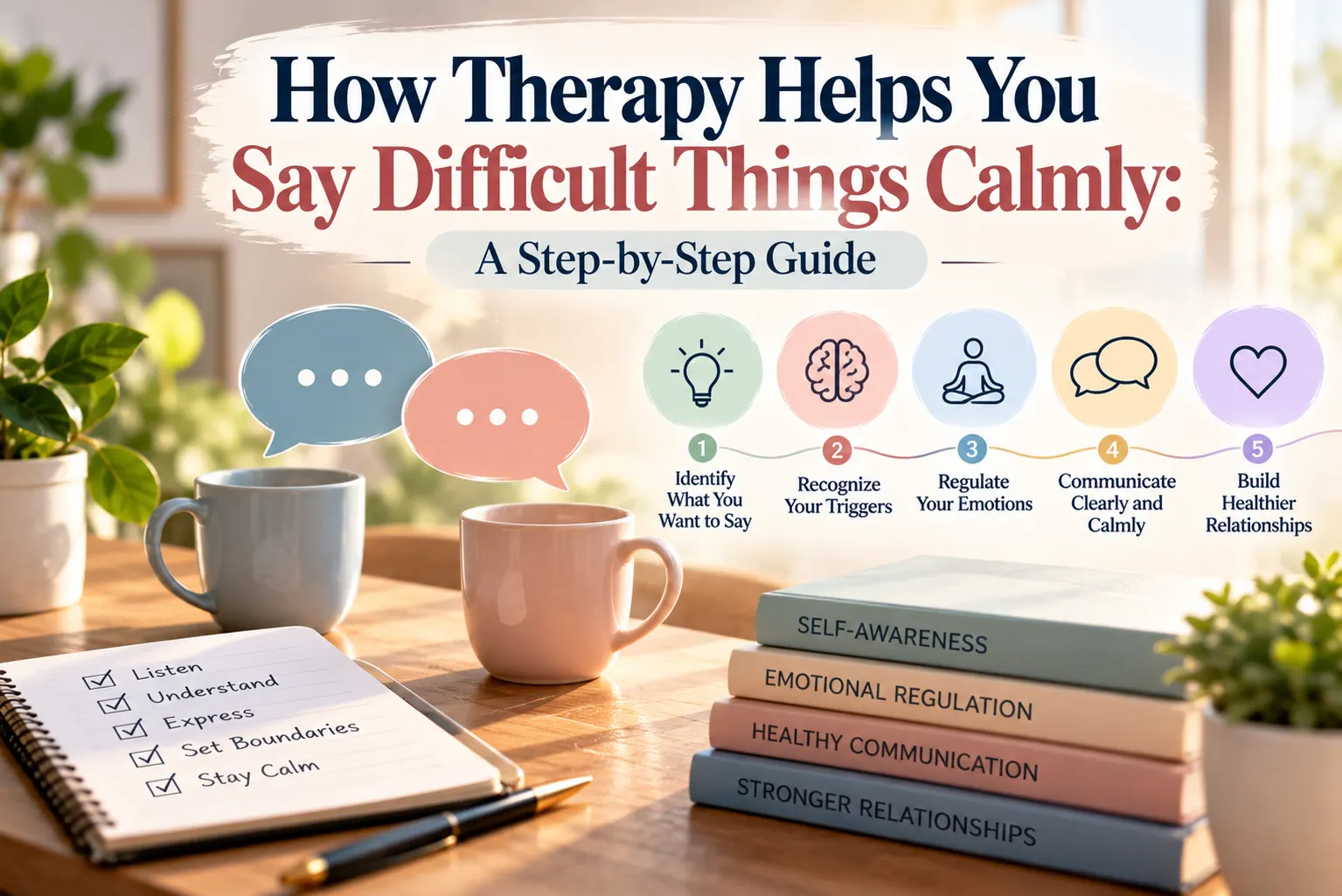
Therapy helps you say difficult things by teaching you to recognize emotional triggers, regulate your reactions, communicate your needs clearly, and respond thoughtfully rather than impulsively. With practice, challenging conversations can become opportunities for understanding instead of sources of ongoing stress.
In this guide, we’ll explore how therapy can help you communicate more calmly, the techniques you can practice, and when professional mental health support may be useful.
Why Is It So Difficult to Say What You Really Feel?
Difficult conversations are rarely just about choosing the right words. They often involve emotions, expectations, past experiences, and concerns about how another person might react.
You may worry about hurting someone’s feelings, damaging a relationship, appearing selfish, or being misunderstood. If previous disagreements have led to criticism or rejection, you might also anticipate a negative outcome before the conversation begins.
Common challenges include:
- Fear of conflict: Avoiding disagreement because it feels uncomfortable or threatening.
- People-pleasing: Prioritizing other people’s expectations over your own needs.
- Emotional overwhelm: Becoming tearful, angry, anxious, or unable to organize your thoughts.
- Overthinking: Rehearsing conversations repeatedly without feeling prepared.
- Difficulty setting boundaries: Feeling guilty when saying no or asking for a change.
- Fear of rejection: Worrying that honesty will damage an important relationship.
These reactions do not necessarily mean you lack communication skills. Sometimes, your emotional response makes it difficult to use the skills you already have.
Therapy can help you understand these patterns and develop healthier ways to respond.
How Therapy Helps You Say Difficult Things: A Step-by-Step Guide
Step 1: Identify What You Actually Want to Communicate
Before starting a difficult conversation, it helps to understand what you want the other person to know.
When emotions are strong, several concerns can become tangled together. You might want to address a specific incident while also feeling frustrated about similar situations from the past.
For example, instead of simply thinking, “My coworker never respects my time,” identify the specific issue: “I feel frustrated when meetings are scheduled over my existing commitments without checking my availability.”
Therapy can help you separate observable events from assumptions, interpretations, and emotional reactions.
A therapist may encourage you to ask yourself:
- What specifically happened?
- What am I feeling about it?
- What do I need the other person to understand?
- What change or outcome am I hoping for?
This process helps you enter conversations with a clearer purpose instead of trying to resolve every frustration at once.
Step 2: Recognize Your Emotional Triggers
Sometimes, a seemingly small disagreement creates a surprisingly intense reaction.
A partner’s tone, a manager’s criticism, or a family member’s dismissive comment may trigger feelings connected to previous experiences. You might become defensive, withdraw, or feel compelled to explain yourself repeatedly.
Therapy provides an opportunity to explore these emotional patterns without judgment.
Depending on your needs, a therapist may use approaches such as cognitive behavioral therapy (CBT) to help you examine the relationship between thoughts, feelings, and behaviors.
For instance, the thought “If I disagree, they will stop respecting me” may increase anxiety and make it harder to express your opinion.
Recognizing this thought gives you an opportunity to question whether it reflects the current situation or an expectation shaped by previous experiences.
The goal isn’t to eliminate every uncomfortable emotion. It’s to understand your reactions well enough to make more deliberate choices.
Step 3: Learn to Regulate Your Emotions Before Speaking
Calm communication does not mean feeling completely relaxed. It means developing ways to manage your emotional response so that you can express yourself more effectively.
Therapy may introduce practical strategies such as:
- Taking a few slow, comfortable breaths.
- Relaxing your shoulders and unclenching your jaw.
- Pausing before responding to a provocative comment.
- Naming the emotion you’re experiencing.
- Asking for a short break when you feel overwhelmed.
Imagine that a family member makes a comment that feels disrespectful. Instead of immediately responding with anger, you notice your tension, pause, and give yourself a moment to choose your words.
You might say, “I want to talk about this, but I need a moment to collect my thoughts.”
This pause can help you respond intentionally rather than reacting automatically.
If a conversation becomes too intense, taking a break and agreeing to return to the discussion later can be more productive than forcing yourself to continue.
Step 4: Practice Using Clear, Direct Language
When people feel anxious about conflict, they sometimes communicate indirectly. They may hint at a problem, apologize excessively, or hope the other person will recognize what they need without being told.
Unfortunately, indirect communication can create confusion.
Therapy can help you practice expressing concerns in a way that is respectful, specific, and easier to understand.
For example:
Instead of: “You never listen to me.”
Try: “I feel unheard when I haven’t finished explaining my point. Could you let me finish before responding?”
The second statement identifies the behavior, explains its impact, and makes a clear request without turning the conversation into a judgment about the other person’s character.
You can also use this simple structure:
- Describe the situation.
- Explain how it affects you.
- State what you need or would like to change.
- Invite a constructive response.
The purpose is not to control the other person’s reaction. It is to communicate your perspective honestly while leaving room for dialogue.
Step 5: Learn to Set Boundaries Without Excessive Guilt
Setting boundaries can feel particularly difficult when you are accustomed to keeping others happy.
You might agree to extra responsibilities even when you’re exhausted, tolerate comments that make you uncomfortable, or avoid declining requests because you fear disappointing someone.
Therapy can help you understand the difference between being considerate and neglecting your own needs.
A boundary communicates what you can accept, what you are available for, or what you will do to protect your well-being.
For example:
- “I can’t take on another project this week.”
- “I’m happy to discuss this, but I don’t want to continue while we’re shouting.”
- “I need some time to think before making a decision.”
- “I care about you, but I can’t be available for calls throughout the workday.”
You don’t need to provide a lengthy explanation every time you express a limit.
With practice, you can learn to tolerate the discomfort that sometimes accompanies setting boundaries without automatically abandoning them.
Step 6: Challenge the Fear of Being Misunderstood
One reason people avoid difficult conversations is the belief that they must explain themselves perfectly.
They may rehearse every sentence, anticipate every objection, and repeatedly revise their message to prevent the other person from reacting negatively.
This can make conversations feel exhausting before they even begin.
Therapy can help you examine the expectations behind this pattern.
For example, ask yourself: “Am I responsible for communicating respectfully, or am I responsible for ensuring the other person agrees with me?”
You can influence how clearly and thoughtfully you communicate, but you cannot completely control another person’s interpretation or response.
Learning to accept this distinction can reduce pressure and make honest communication easier.
You can aim to be clear, respectful, and open to feedback without requiring every conversation to end in agreement.
Step 7: Practice Difficult Conversations in a Supportive Setting
Understanding communication techniques is helpful, but applying them under pressure can be challenging.
Therapy may provide a space to practice conversations before having them in everyday life.
Depending on the therapeutic approach, you might role-play a discussion with a partner, rehearse a workplace boundary, or practice responding to criticism without becoming defensive.
For example, if you need to tell your manager that your workload is becoming unmanageable, you could practice saying:
“I want to continue delivering high-quality work, but my current workload is making it difficult to meet all the deadlines. Could we review priorities and decide what needs to come first?”
You can then explore how to respond if your manager disagrees, asks questions, or proposes a different solution.
This kind of practice can help you feel more prepared while allowing you to refine your words and approach.
Step 8: Learn to Listen Without Immediately Defending Yourself
Difficult conversations involve more than expressing your own feelings. They also require listening to another person’s perspective.
When you anticipate criticism, you may spend the entire conversation preparing a defense rather than understanding what the other person is saying.
Therapy can help you practice active listening, emotional awareness, and more thoughtful responses.
Useful phrases include:
- “Can you explain what you mean?”
- “I want to understand your perspective.”
- “Let me make sure I’ve understood you correctly.”
- “I see this differently, but I understand why it matters to you.”
Listening doesn’t mean agreeing with everything the other person says. You can acknowledge their experience while maintaining your own perspective and boundaries.
This approach can reduce unnecessary escalation and create more room for constructive discussion.
Step 9: Reflect on the Conversation Without Judging Yourself
Not every difficult conversation will go smoothly.
You might become emotional, forget what you intended to say, or realize afterward that you could have expressed something differently.
Instead of treating the experience as a failure, use it as an opportunity to learn.
After a conversation, consider:
- Did I communicate the main issue?
- Was I able to recognize my emotional triggers?
- Did I express my needs clearly?
- What helped me stay grounded?
- What would I like to try differently next time?
Therapy can help you reflect on these experiences without turning them into another reason to criticize yourself.
Progress may look like speaking up once when you previously stayed silent, recognizing that you need a break, or expressing disagreement without abandoning your own needs.
These small changes can gradually support greater confidence in communication.
Step 10: Build Consistency Through Everyday Practice
Calm communication is a skill that develops over time. You don’t have to begin with the most emotionally charged conversation in your life.
Start with manageable situations, such as expressing a preference, declining a minor request, or asking someone to clarify a misunderstanding.
As you become more comfortable, you can apply the same principles to more challenging conversations.
You may find it helpful to keep a short journal of situations that trigger anxiety, the thoughts you notice, and the communication strategies you try.
Over time, these observations can help you recognize recurring patterns and identify areas where additional support may be useful.
Remember that progress isn’t always linear. Stress, fatigue, and difficult circumstances can affect how effectively you communicate on a given day.
The goal is not perfect communication. It is greater awareness, flexibility, and confidence in expressing yourself.
How Do You Know When Therapy May Help?
Consider speaking with a mental health professional if fear of difficult conversations regularly affects your relationships, work, or emotional well-being.
Therapy may be worth exploring if you frequently avoid conflict, struggle to establish boundaries, experience intense anxiety before speaking up, or find yourself repeating communication patterns you want to change.
It can also help when difficulties communicating are connected to broader concerns, such as persistent anxiety, low mood, relationship stress, or experiences from the past.
Different therapeutic approaches serve different needs, and the right approach depends on your circumstances and goals.
A mental health professional can help you explore what you’re experiencing and discuss appropriate options for support.
Explore Mental Health Support With Christine Bilbrey, MD, PC
Learning to express difficult feelings calmly can be an important part of emotional well-being, healthier relationships, and personal growth.
At Christine Bilbrey, MD, PC, individuals can explore mental health care options that align with their needs and goals. The practice focuses on personalized, integrative psychiatric care, with attention to the individual factors that may influence emotional health.
If anxiety, stress, mood concerns, or other mental health challenges are making everyday communication more difficult, professional guidance may help you better understand your experiences and consider appropriate next steps.
Therapy and psychiatric care are not interchangeable, and the most suitable support depends on your individual needs. Visit the practice website to learn more about its services and available care options.
Take the next step toward understanding your mental health: Visit Christine Bilbrey, MD, PC to explore the practice and learn more about available support.
Final Thoughts
Learning to say difficult things calmly is not about suppressing your emotions, avoiding disagreement, or making everyone happy. It is about understanding your reactions, communicating your needs clearly, and responding to challenging situations with greater intention.
Therapy can help you develop these skills through emotional awareness, practical communication strategies, and opportunities to practice new responses. With time, difficult conversations may become more manageable, even when the outcome remains uncertain.
You deserve to express your thoughts and needs without feeling that every disagreement is a personal failure.
If emotional distress or anxiety is affecting your relationships and everyday life, consider exploring appropriate mental health support. Christine Bilbrey, MD, PC offers personalized psychiatric care for individuals seeking to better understand and address their mental health concerns.
Visit www.bilbreypsychiatry.com to learn more.
FAQs
Can therapy help me communicate difficult feelings calmly?
Yes. Therapy can help you recognize emotional triggers, manage anxiety, clarify your needs, practice assertive communication, and develop strategies for handling challenging conversations more thoughtfully.
Why do I become emotional during difficult conversations?
Difficult conversations can activate fears of rejection, criticism, conflict, or misunderstanding. Past experiences, current stress, and individual emotional patterns may also contribute. Therapy can help you explore these reactions and develop ways to manage them.
What type of therapy helps with communication problems?
Cognitive behavioral therapy may help you examine unhelpful thoughts and behavioral patterns. Other approaches may focus on emotional awareness, interpersonal relationships, boundaries, or past experiences. A qualified mental health professional can help determine which approach may suit your needs.
How can I stay calm when someone disagrees with me?
Pause before responding, notice your emotional reaction, and focus on understanding the disagreement rather than immediately defending yourself. Use clear statements, ask questions, and take a break if the conversation becomes overwhelming.
How do I set boundaries without feeling guilty?
Start by identifying your needs and communicating them respectfully. Remember that a boundary is not necessarily a rejection of another person. Therapy can help you explore the beliefs and fears that make setting limits difficult.
How long does it take to improve communication through therapy?
There is no universal timeline. Progress depends on your goals, circumstances, therapeutic approach, and opportunities to practice new skills. Some people notice useful changes early, while others benefit from ongoing support.
Is therapy helpful if I avoid conflict completely?
Therapy may help you understand why conflict feels difficult and gradually practice expressing your needs. The process can involve building emotional awareness, tolerating discomfort, and learning that respectful disagreement does not always threaten a relationship.
Can psychiatric care help if anxiety makes communication difficult?
Psychiatric care may be appropriate when communication difficulties occur alongside anxiety, mood symptoms, or other mental health concerns. A psychiatrist can assess your symptoms and discuss suitable treatment options. Depending on your needs, care may involve medication, psychotherapy referrals, or other approaches.
What should I do if a difficult conversation becomes unsafe?
Your safety comes first. If someone becomes threatening, abusive, or violent, prioritize getting to a safe place rather than trying to communicate more effectively. Seek appropriate professional or emergency support when necessary.